Dissonancy: Sensory ethics data for everyone.
2026 · Figma Design-a-thon

Our team began Dissonancy with worldbuilding, leaning into the fantastical possibilities of the design prompt. Rather than developing a sensory-tracking app for immediate use, we explored how speculative design could help us imagine more honest and trustworthy systems. Setting practical constraints aside gave us room to question the social structures that limit large-scale change.
Created by Joey Huang, Eva Judd, and Cayenne Feng, Dissonancy explores ethical dissonance: the internal conflict that can arise when a decision clashes with someone’s personal values. In our speculative system, a voluntary neural sensor detects these signals in participating elected officials and translates them into public-facing indicators alongside political actions.
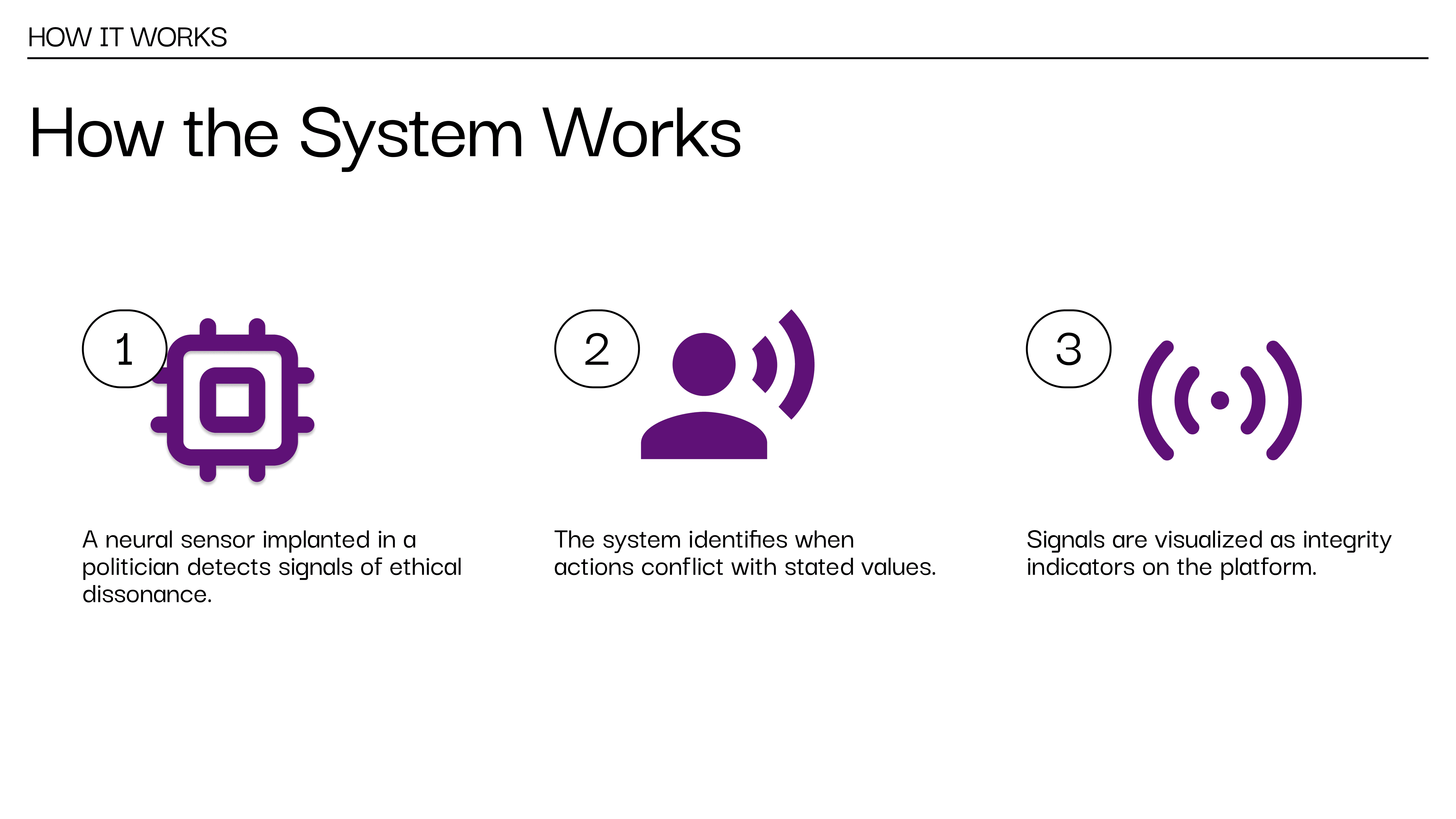

We initially imagined a tool for personal accountability: an alert that would help someone recognize when their actions conflicted with their own values. Our shared background in cognitive psychology shaped this direction. We had studied how social roles and situations can influence behavior, even when that behavior contradicts a person’s moral beliefs. This led us to consider roles where abuses of power can have wider consequences, including policing and government. Our focus shifted toward a deliberately dystopian future in which implanted microchips make high-ranking officials’ ethical dissonance data publicly accessible. The concept does not promise moral integrity or treat a signal as proof of wrongdoing. Instead, it asks whether access to such information could help the public scrutinize people in power and make more informed voting decisions.
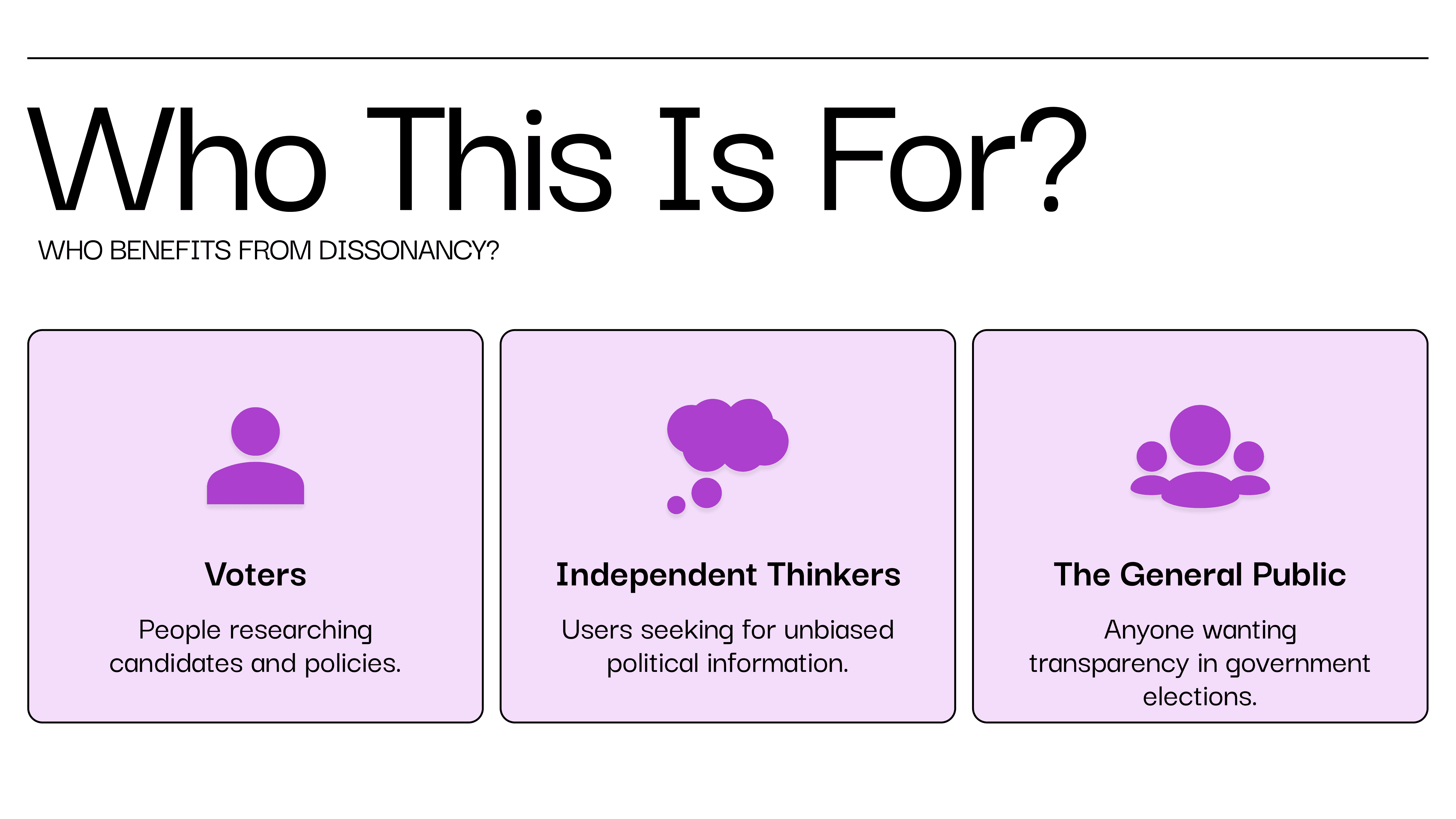
The presentation focuses on voters researching candidates, people seeking information beyond party labels, and the wider public interested in government transparency. We illustrated these needs through fictional scenarios: a first-time voter finding a starting point for research, an elected official reconsidering a conflict of interest, and an independent voter choosing to hide party affiliations. These are design scenarios, not findings from user testing.
The landing page brings together trending politicians and recent signals. Individual profiles connect a leader’s dissonance indicators over time with specific political actions, giving the numbers context rather than presenting a score alone.

Translating the concept into an interface exposed tensions between our imagined future and what a real system could support. Some challenges were social and ethical, including the implications of implanting microchips and publishing sensitive data. Others came from the database structure and the difficulty of representing an intangible experience as measurable information. We prioritized a coherent speculative world and an intuitive UI rather than presenting the technology as feasible. The process highlighted a central design question: how do you communicate something as subjective as ethical dissonance without making the data seem more definitive than it is?
Our presentation proposes four safeguards within this imagined system: no tracking of voters or ordinary users; voluntary, opt-in participation by elected officials; standardized signals that political campaigns cannot edit; and public indicators accompanied by contextual political events. These are design intentions, not implemented or validated protections. They helped us examine the tension between public accountability, privacy, and the risk of treating an internal signal as an objective judgment of character.

We started the project unfamiliar with Figma, and most of us were also new to the pace of a design-a-thon. Working together in person on a shared design file made learning collaborative: when someone got stuck, a teammate could point to the issue and help resolve it in context. We began with Figma Make to explore ideas, then moved through FigJam, drafts, components, interface design, and prototyping. Tutorials, YouTube videos, and hands-on experimentation helped us work through roadblocks. Beyond learning the tools, we gained experience turning an ambitious shared concept into a prototype under time pressure.